
5 Beginner-Friendly Board Games That Also Look Great On The Table
It's all about that table presence, baby!

FILLER GAMES
As it often happens with game nights, you’ll find yourself with a couple of players at the table while you wait for the whole gang to arrive. In these situations, it’s always good to have a light filler game in your back pocket that you can use to satiate your hunger before the main course.
Botswana
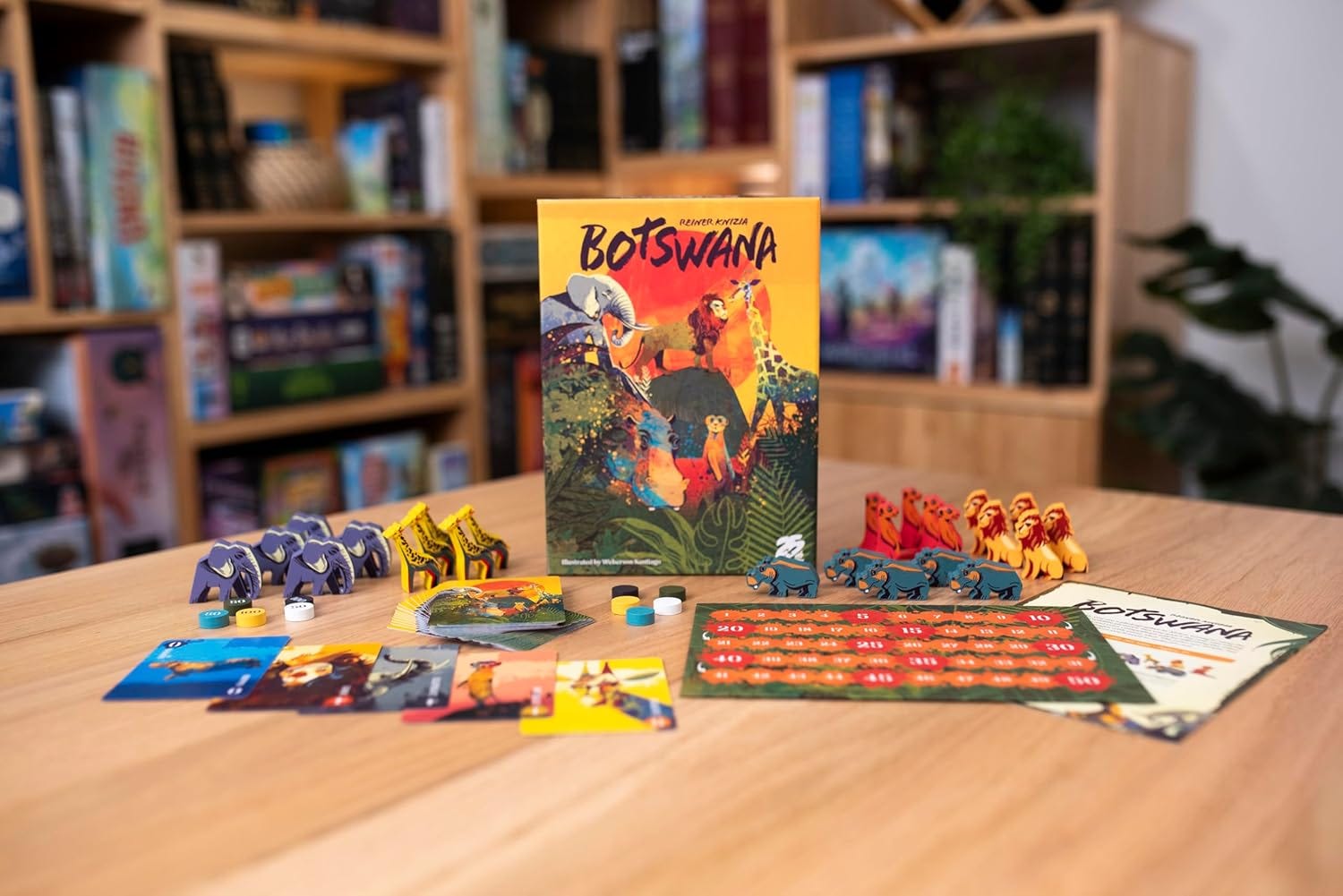
Publisher: 25th Century Games
Category: Card Game
Primary Mechanics: Commodity Speculation, Hand Management, Open Drafting, Stock Holding
Player Count: Best with 4 players.
Playing Time: 20-30 minutes
Brief Overview
In thematic terms, players assume the roles of competing African wildlife photographers who try to capture the most profitable wildlife portraits while also decreasing the value of their competitors’ portraits.
In game terms, players are investing in five different stocks or commodities (represented by animals). There are five animals/commodities: lions, hippos, giraffes, meerkats, and elephants.
The game is played over several rounds equal to the number of players. To start, players must set aside two to three cards from the deck facedown, depending on the number of players, and secretly remove them from the game. Next, shuffle the deck of cards and distribute them equally among all the players.
Turn Sequence
Play a card (the cards range from zero to five) under a single animal pile to form a column of cards.
After playing your card, you must select one animal figure, and it can be any animal of your choice.
Here’s the catch: Each animal piece/token you claim will be worth an indeterminate amount of points by the end of the game. The value of each animal token/figure isn’t static and will fluctuate throughout the game.
Using the image below as an example: Colin plays the solitary one-value blue hippo card and takes a lion figure, which is worth two points a pop because the bottommost visible card in the lion column is a two-value card. Each time you play an animal card, you place it at the bottom of the corresponding animal’s card column, setting the current value for that animal. For this example, meerkats are worth 2, elephants 0, giraffes 2, hippos 1, and lions 2, but those values will change over time.
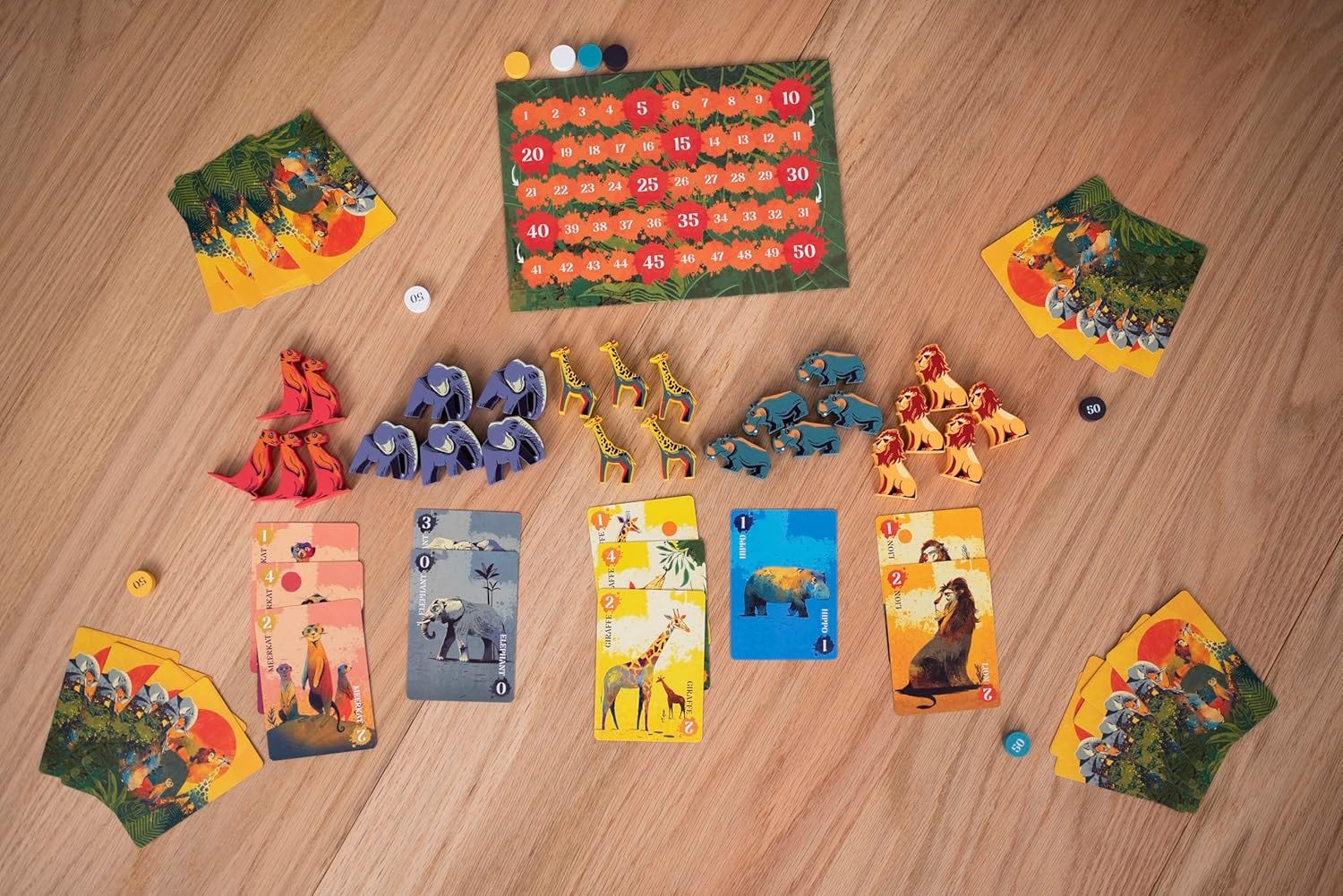
Example 2: Each wooden lion piece you own is worth two points each because there is a two-lion card at the bottom of the lion card column. There is only one hippo card, so hippos are currently only worth one point each. Theoretically, If you had two lion pieces and one hippo piece at this point in the game, you’d have five points!
Note: Keep in mind that there is a finite amount of animal pieces, so once they are gone, they are gone.
Round End
A round ends once someone plays the sixth card of an animal. At that point, players count their points, reshuffle all the cards, take out 2 or 3 cards in secret out of the deck, and start a new round, repeating the same process over again.
Game End
The game ends as soon as a player plays through all the pre-established rounds. Once the game ends, players count the value of each animal piece according to their final values. Whoever has the most points wins! It’s that simple!
To summarize the game flow again:
You play an animal card in its matching column, temporarily changing the value of that animal.
You grab a single animal piece/token, which will be worth an unknown amount of victory points at the end of the game.
Pros
Small box and accessible price point.
Fast playtime paired with elegant rules and satisfying gameplay.
Imperfect information prevents card counting and analysis paralysis.
Cute animal meeples and vibrant illustrations by Weberson Santiago.
Easy way to introduce folks to stock games and commodity speculation.
You can lock players out of certain animals to benefit yourself or hinder them.
Being able to take any animal you want allows for fascinating decisions and counterplay.
Players must pay close attention to the value of their cards and the values of the cards played by others.
The game has room for light bluffing by playing certain cards and taking certain animals in a specific order.
Considerations
Botswana may be a bit too “pure” for some people.
The constantly changing values may be a tad chaotic for some players.
PARTY GAMES
Party games are an essential part of any gamer’s collection. They are perfect for large gatherings and parties since they have simple rules and cater to large groups of people. Unfortunately, not all party games are made the same. Here are some entry-level party games with awesome table presence that you can enjoy with casual gamers without sacrificing enjoyment or juicy decisions.
Magical Athlete
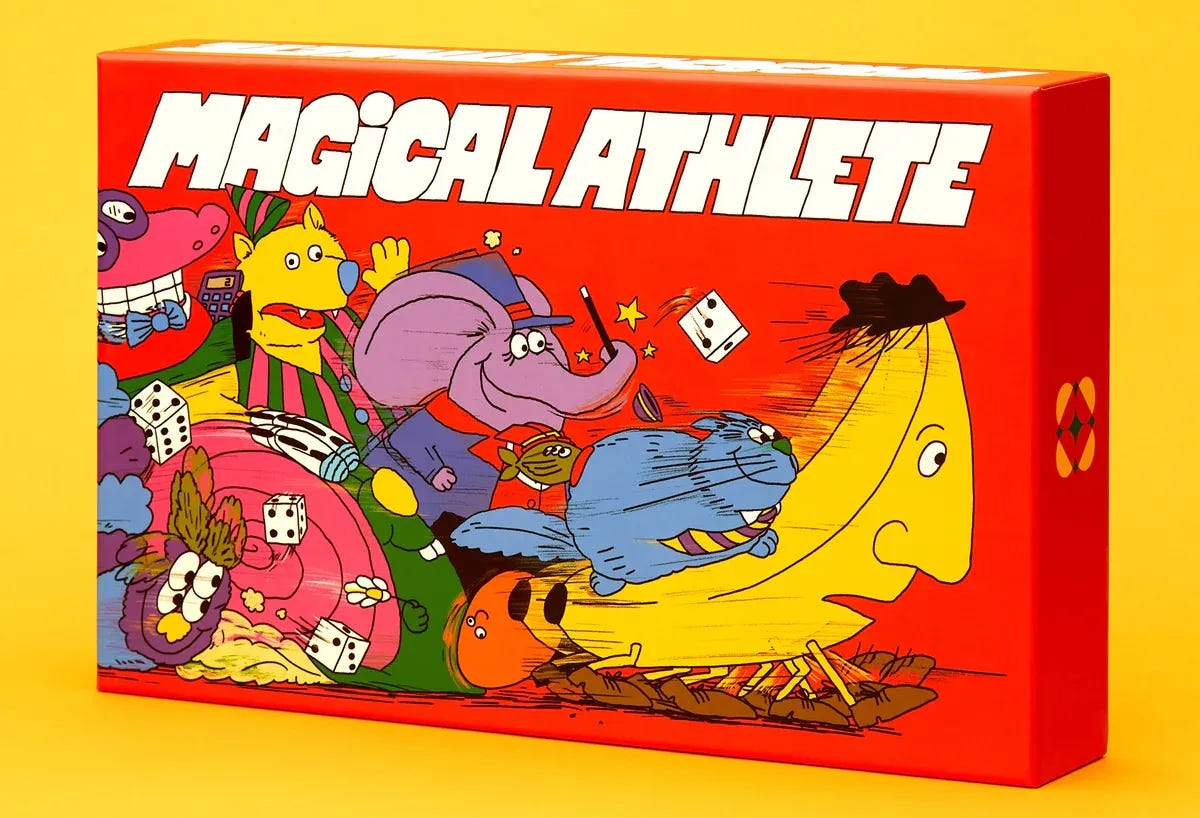
A breakout hit in 2025, Magical Athlete is a remake of a long out-of-print cult classic racing game. In just under a year, it has already climbed its way up Board Game Geek’s top 100 family and party games of all time.
Publisher: CMYK
Category: Racing Game
Main Mechanics: Roll-and-move, Open Drafting, Variable Player Powers
Player Count: 2 to 6 players. Best with 5 to 6 players.
Playing Time: 30 to 50 minutes.
Brief Overview
Magical Athlete is a frenetic roll-and-move racing game that features a cast of quirky characters with crazy abilities. Players will roll their dice and activate racer abilities if applicable. The goal of the game is to finish in first or second place over the course of four races to gain victory point trophies. Once the fourth race concludes, players count points and determine a winner.
Setup
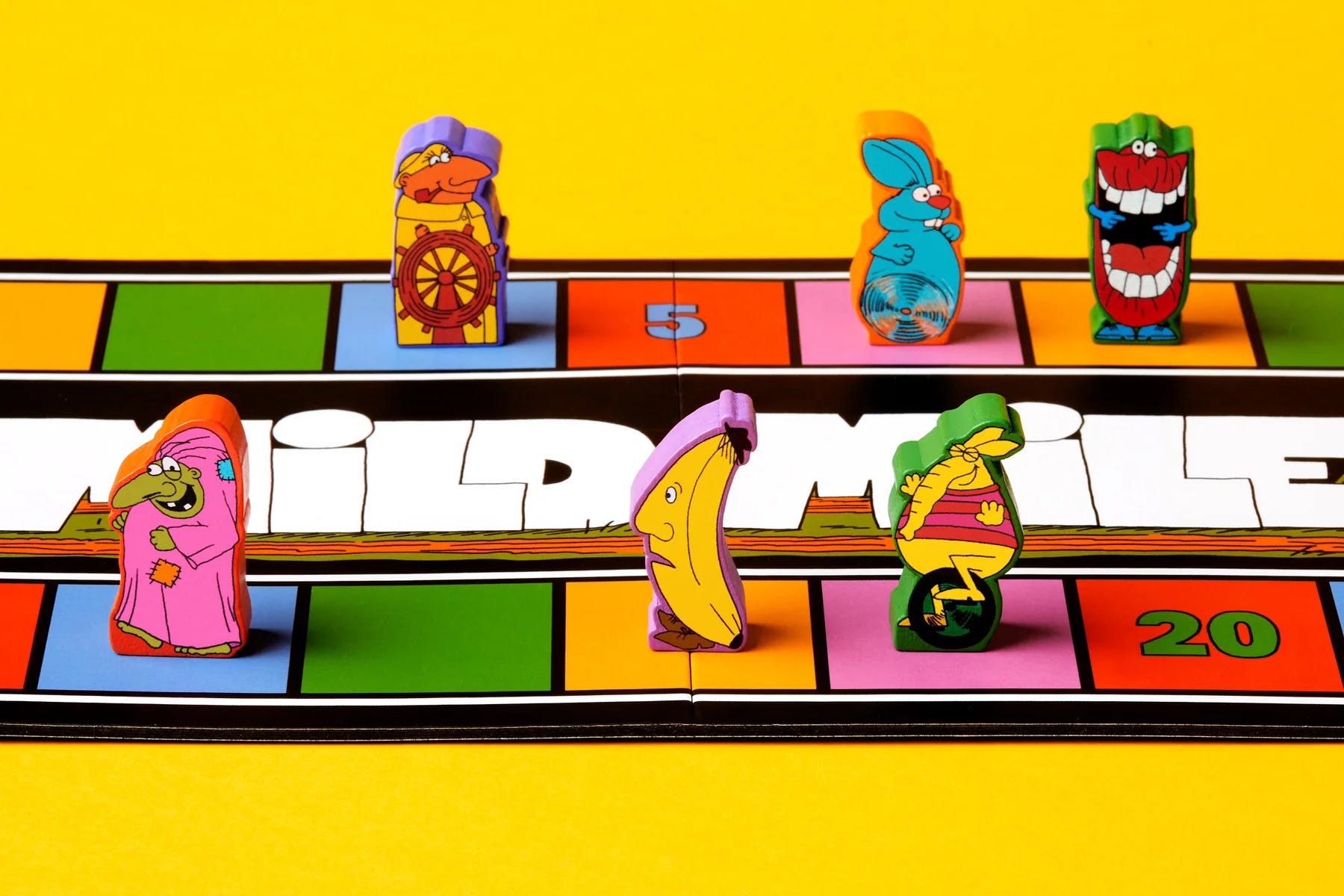
At the start of the game, each player will draft a team of four racers. There will be 2 races on a basic track and 2 races on another track with special spaces. You'll always use one racer per race, unless you’re playing an optional three-player mode where you can control two racers per race.
Rules
The game rules are very basic: on your turn, you’ll roll the dice, move your racer that many spaces, and activate any applicable abilities. That’s it!
Tracks
The first track, “Mild Mile,” is just a basic track without anything special. The second track, “Wild Wilds,” features special spaces that either award victory points, shoot you forward, push you backward, or make you trip. When tripped, you lose your next turn and stand up.
Note: Some racer abilities work better on the wild wilds track, while others work better on the mild mild track.

Racer Abilities
There are various racer abilities that do different things, including hopping over players, tripping them, teleporting them, knocking them backward, swapping spots with other racers, and more.
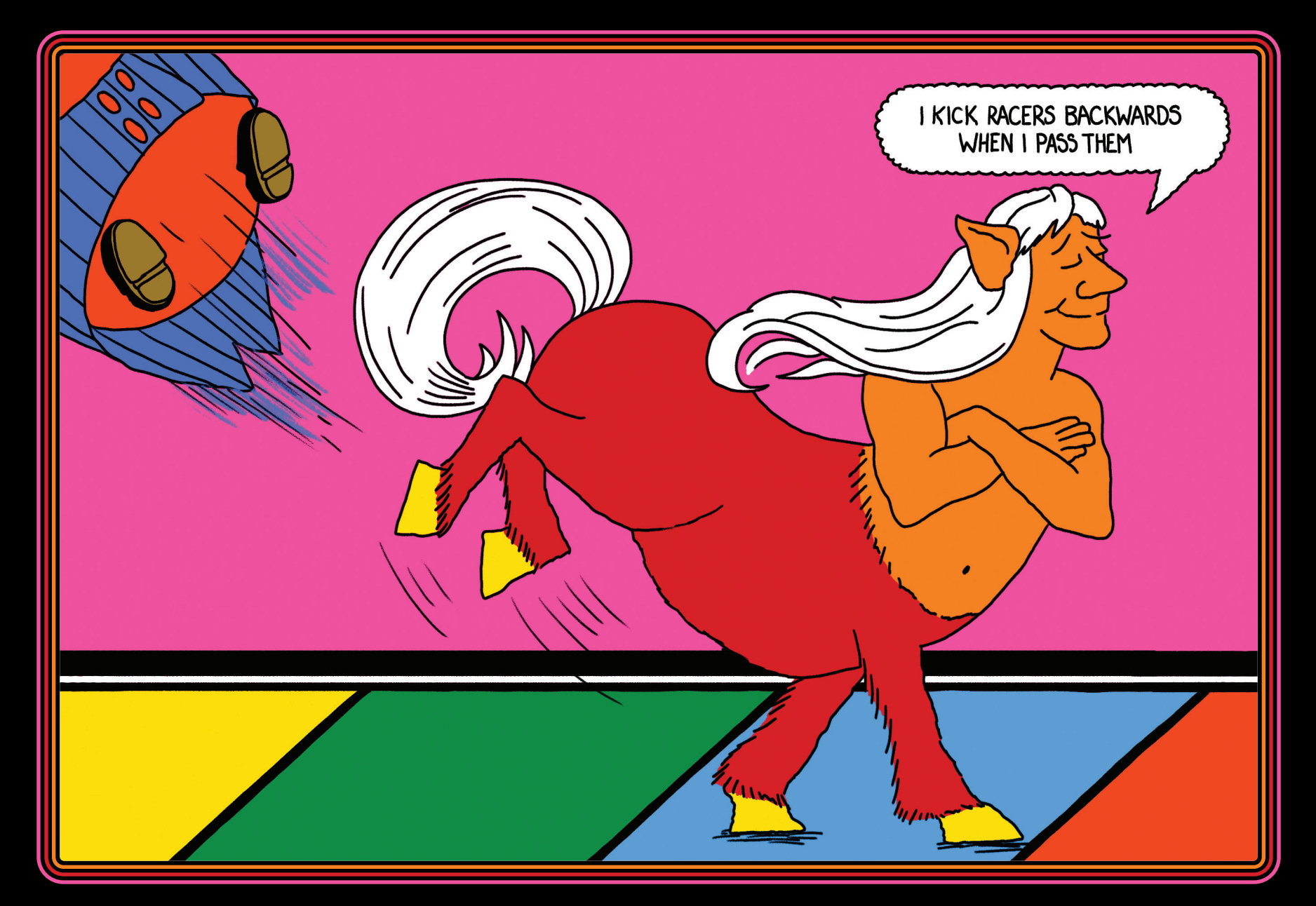
On paper, Magical Athlete is a game with rules that seem quite dated by modern standards. So, why has this game taken the industry by storm? Let’s break it down.
Pros
Fast-playing game that’s quick to setup and teardown.
Incredibly simple rules that casual gamers can easily internalize.
The game features an unusual art style that gives it a unique aesthetic, setting it apart from most other board games.
The game produces frenetic, nail-biting races that will have you and your friends laughing and gasping until the very last minute.
This game diverts from the typical deduction and word puzzle mechanisms found in many party games.
It is incredibly addicting and exhilarating, leaving you wanting more after each game.
There is a 3-player variant that allows you to play with two racers each, creating smart combos between your racers and allowing for greater strategy.
While luck plays a role in the game, there is still some room for strategy when it comes to picking racers best suited for certain tracks and trying to combo off of your opponents’ racers.
It’s a rare kind of game that encourages custom rules and fan-made racers without breaking the game’s balance.
Considerations
A common complaint this game receives from hardcore gamers is that it’s completely random, but I don’t fully agree with that assessment. Although you’re at the mercy of the dice, there’s still strategy, and many racer powers are designed to keep players close together on the track, ensuring all players are contenders to win. Furthermore, It’s a party game, so I'm not really concerned about the random dice rolls. All I care about is having a fun time with my friends.
I also believe the bare-bones rules of Magical Athlete are necessary because they make room for the most unique element of the game: the crazy racer abilities. Anything more complicated rules-wise would turn Magical Athlete into a strategy game with slow-moving turns, which is antithetical to the fast-paced, chaotic party nature of the game.
Note: Just because there’s randomness doesn’t mean there is no strategy in the game. While subtle, there is some nuance to picking racers at the right time. It’s also worth noting that, despite the chaos, in most of my plays, all players have finished the game close to each other in victory points. So take that for what it’s worth.
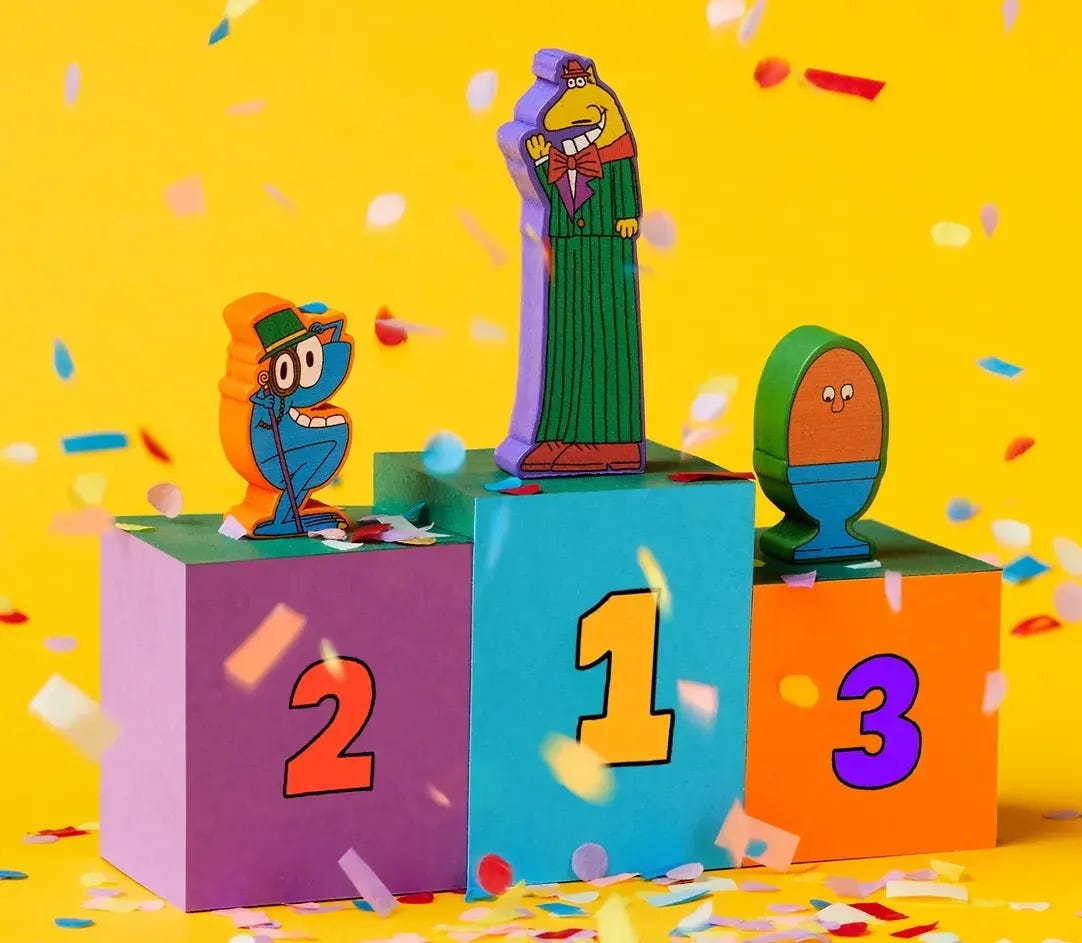
It’s difficult to make a counterpoint to this game. It has very basic rules and random roll-and-move mechanisms that most contemporary board games avoid like the plague. Yet, the game is still so dang fun. As long as you know what you’re getting into and manage everyone’s expectations accordingly, you and your friends will have a great time with Magical Athlete.
If you’d like to learn more about the game in detail, check out my first impressions below:

Hot Streak

Like Magical Athlete, Hot Streak has quickly risen to the 5th spot on BoardGameGeek’s Top 100 family games, extending CMYK's successful streak of games (no pun intended).
Publisher: CMYK
Category: Racing Game
Mechanics: Betting and Bluffing, Open Drafting
Player Count: 2 to 8 players. Best with 5 to 6 players.
Playing Time: 20 minutes to 40 minutes.
Brief Overview
In Hot Streak, players draft betting tickets and place side bets on mascots competing in an epic racing showdown. At the start of the game, the dealer draws a certain number of action cards that’ll eventually form a race deck that governs the flow of the race and dictates the movement of the four racer mascots.
The dealer shows the mascot action cards to players at the table, giving them an idea of how the race could potentially unfold based on the distribution of cards and their effects (see image below). Finally, the dealer hands each player three cards. Once players have seen their dealt cards, they will select two betting tickets (mascot bets or weirder side bets that are situational). Once players pick their bets, they can each insert a secret card into the racing deck before the race, effectively manipulating the race deck.
Using the image below, the yellow cards that control Mum (the crown mascot) are quite awful, encouraging players to bet on other mascots instead.
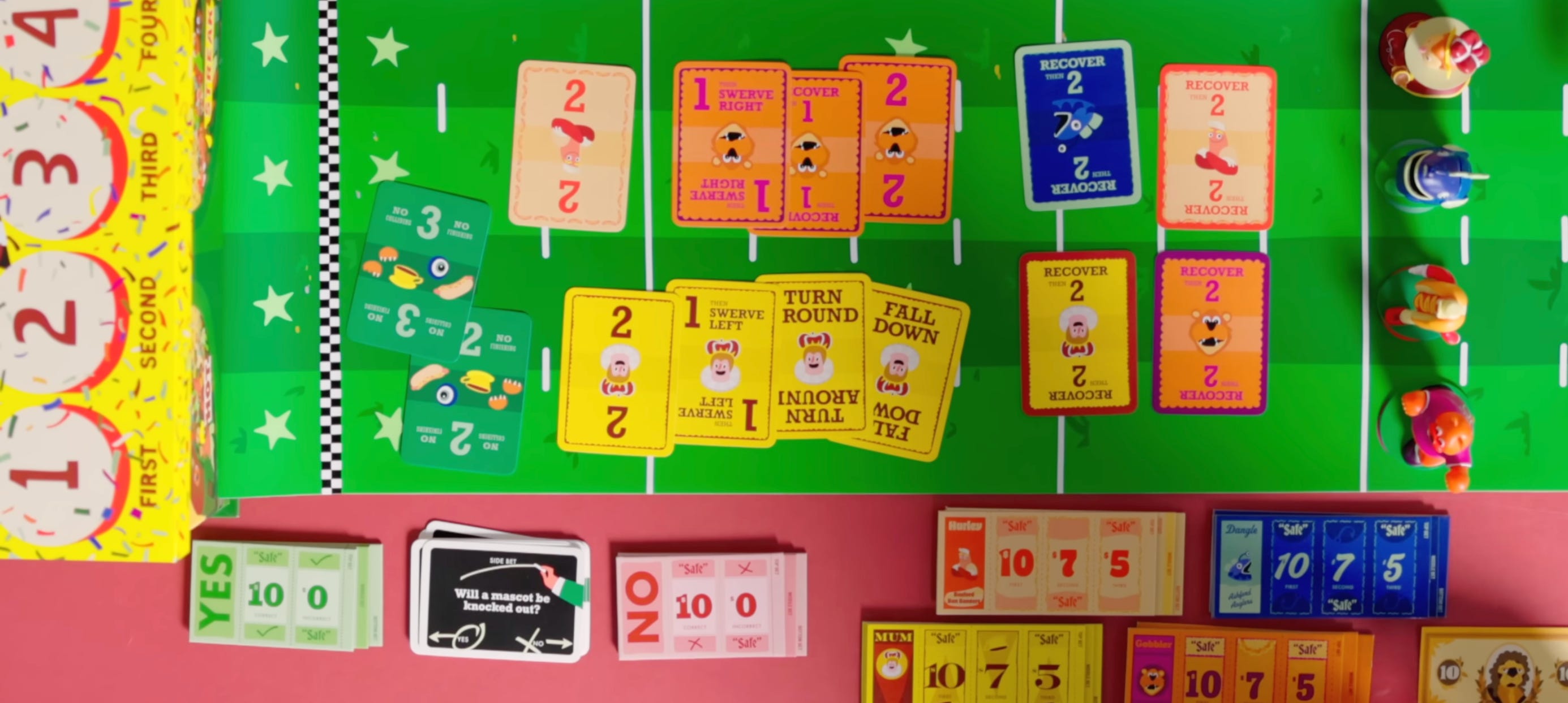
Players start the race by revealing one action card at a time and doing what it says. Action cards can make mascots swerve, fall down, turn around, move ahead, or even fall off the map, eliminating them from the race. Each race ends when at least three mascots have completed it. Players receive payouts for the placement of each mascot and repeat this process two more times. After the third race. the player with the most money wins.
Pros
Fast playtime allows for multiple games in a row.
Room for cheeky play that rewards clever foresight.
The races are frenetic and vary from game to game.
The races come alive as mascots interact with one another in real time.
Although races unfold randomly, players always know most of the cards in the race deck.
Perfect for nights when you want something fun and exhilarating with low rules overhead.
Awesome toy factor due to pre-painted figures and a game box that doubles as a fold-out game board.
Fantastic components, artwork, and overall presentation that are sure to grab the attention of people passing by.
Considerations
Once the race starts, you can’t control how the action cards play out.
Due to the excellent components, the game’s price point is relatively high in comparison to the gameplay depth.
The enjoyment is highly dependent on group energy and is best suited for certain types of groups that don’t mind lighter games.
For further details on how to play Hot Streak, check out the official rules video:
Family Games
Here are some great family-level games for smaller playgroups that are more strategic than party games, yet still approachable and enjoyable for casual gamers of all ages.
Calico
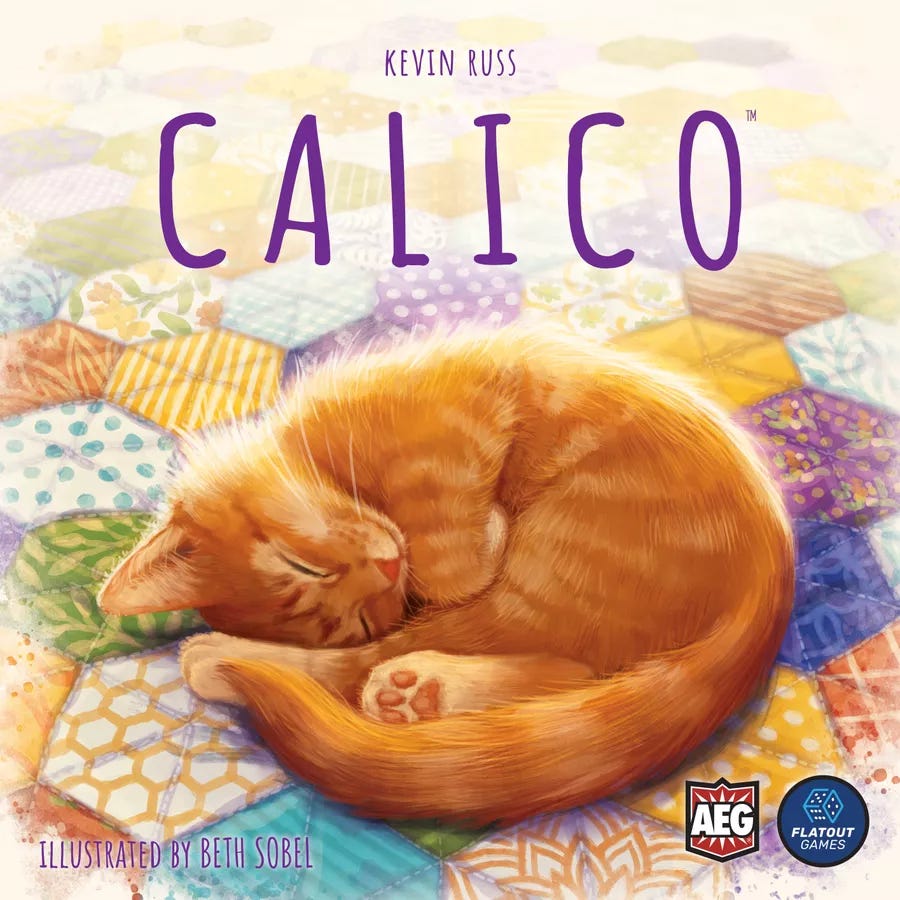
Highly ranked in the BGG top 100 family games, Calico is a popular game that amassed a large following during the COVID pandemic and continues to charm gamers to this day.
Publishers: AEG and Flatout Games
Category: Abstract Strategy
Main Mechanics: Tile Placement, Pattern Building, Grid Coverage
Player Count: 1 to 4 players. Best with 2.
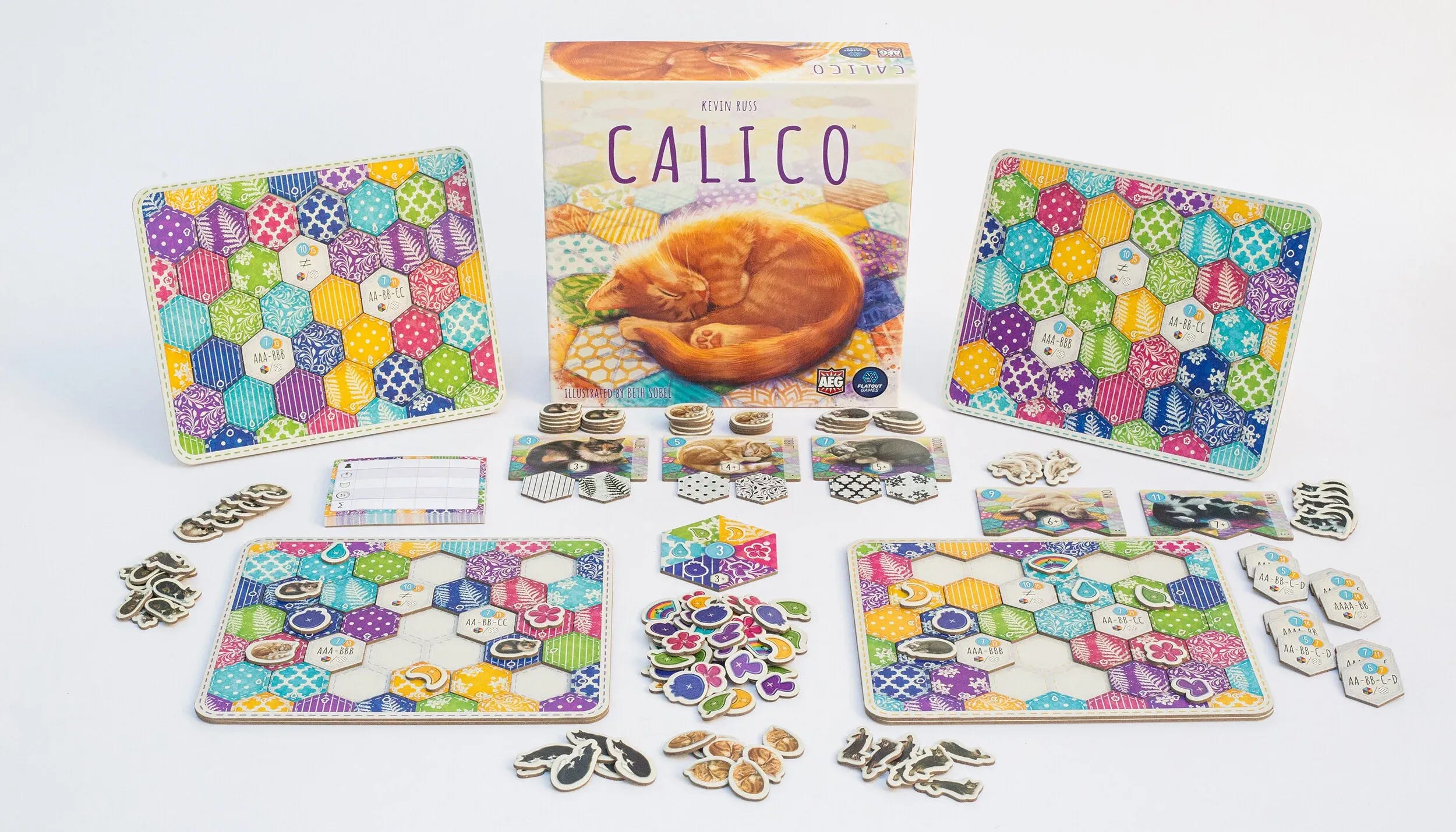
Brief Overview
Thematically, players compete against each other by sewing the coziest quilts to attract cats, satisfy certain pattern goals, and place button tokens. Mechanically, players are playing colored patch tiles to fulfill various pattern requirements and score points.
Setup
Players start with an empty quilt board with 3 goal tokens on it (white tiles with letters).
Draw three colored patch tiles from the bag and lay them out on the table as a public market.
Randomly select three cats: a beginner, a medium, and an advanced cat (each with different pattern requirements and difficulty levels).
Players draw two random colored patch tiles from a bag. These are the players’ starting tiles.
The game begins.
Turn Structure
The turn sequence in Calico is very simple:
Place one of your two available colored patch tiles on your quilt board.
Add any buttons or cat tokens to your quilt if applicable.
Grab one tile from the public tile market.
Refill the tile market with one tile from the bag, bringing the total back to three.
Scoring Points
In Calico, you can earn points in four different ways:
Button Tokens
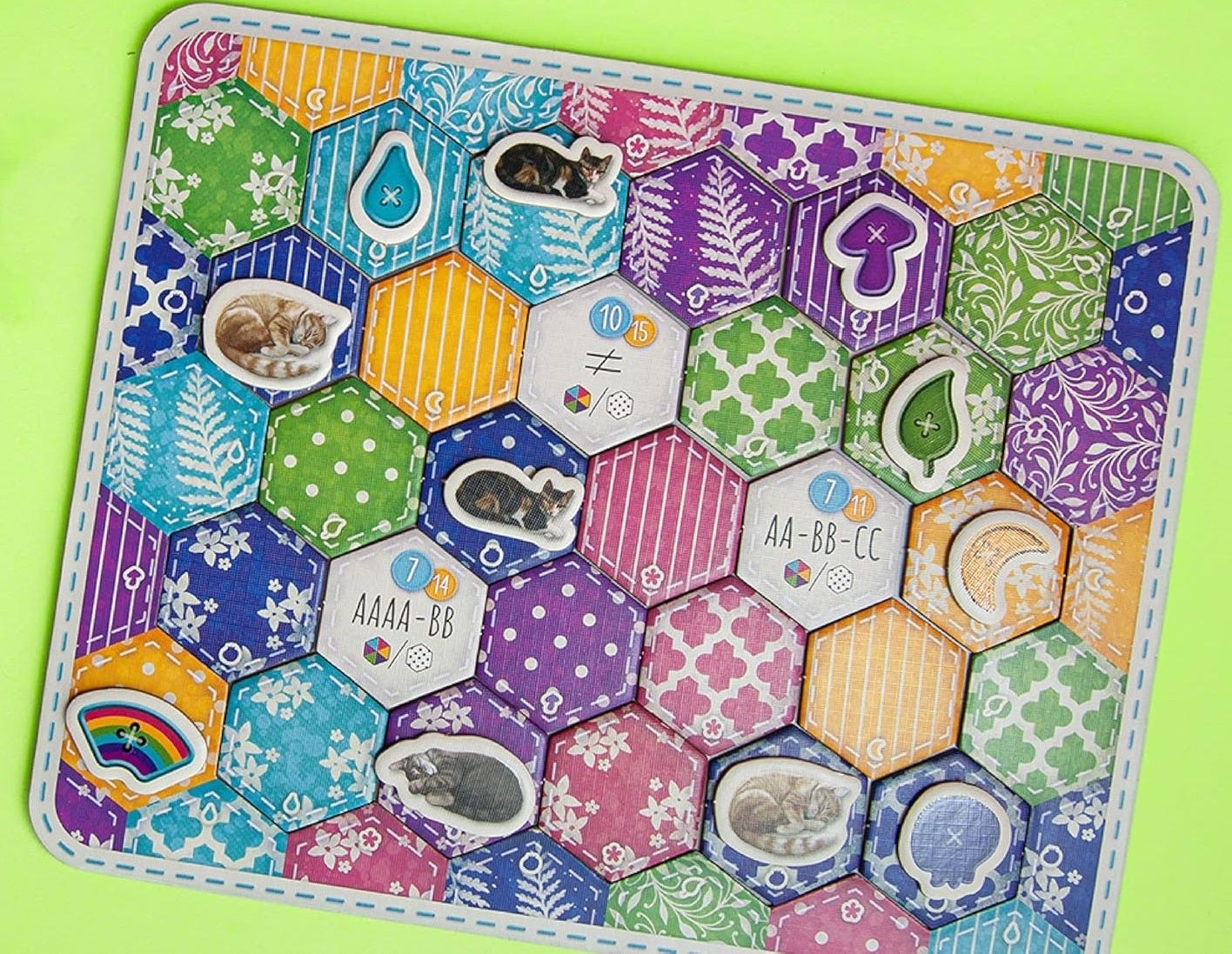
There are 6 different colored buttons in the game. Each time you form an area composed of three contiguous patch tiles of the same color, you can place a button token of the matching color in the corresponding area to mark it as scored. You cannot double-dip or use previously scored spaces (marked by a button token) for other button scoring purposes. Buttons are worth three victory points each.
Rainbow Button Tokens
If you place one button of each color (six colors) on your quilt, you get a rainbow button! A rainbow token is worth three victory points.
Using the image below as an example: Sarah created several areas made up of three tiles of the same color, earning her a light blue, dark blue, green, yellow, and purple token. She should also have a pink token (missing from the picture). Since Sarah got one button of each color, she was awarded a rainbow token (bottom left).
Cat Tokens
Each cat will have different pattern demands for sleeping on your quilt. A cat will come to your quilt when you fulfill its preferred pattern, earning you points.
See the image below: Millie, the cat on the left, grants you 3 points because she is an easy cat to satisfy! Specifically for Millie, you’ll need three or more connected tiles in either of the two patterns below her tile, irrespective of color, because cats are colorblind. Note that you cannot mix and match patterns to fulfill cat demands.
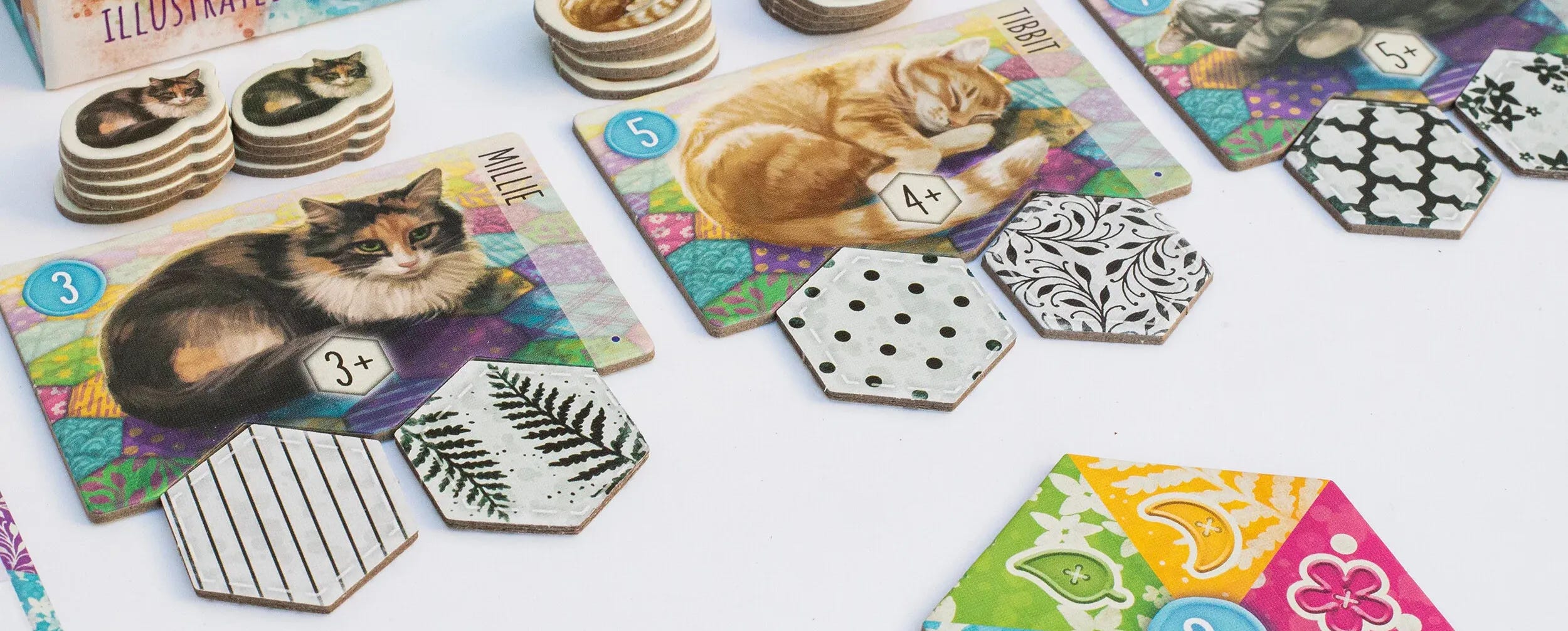
In-game example: On turn 4, Sarah manages to create a connected area with 3 stripe-patterned tiles on her quilt, so she takes a Millie token and places it on the corresponding area to mark it as being scored. On turn 8, she does it again, only this time she does it in another part of her board with the plant-like patterns, scoring a second Millie token.
Once you fulfill a cat’s pattern requirement, place the matching cat token on your quilt board, marking the area so you don’t score it again. Like buttons, you cannot use spaces already scored by one cat for the purposes of scoring another cat. Each cat provides a different number of points, with some cat patterns being harder to achieve than others.
Design Goal Tiles
The main way to score points in Calico is through design goal tiles. To score design goal tiles, you must surround them with sets of tiles while also fulfilling various conditions. Goal tiles will award you points in two ways: color demands and pattern demands.
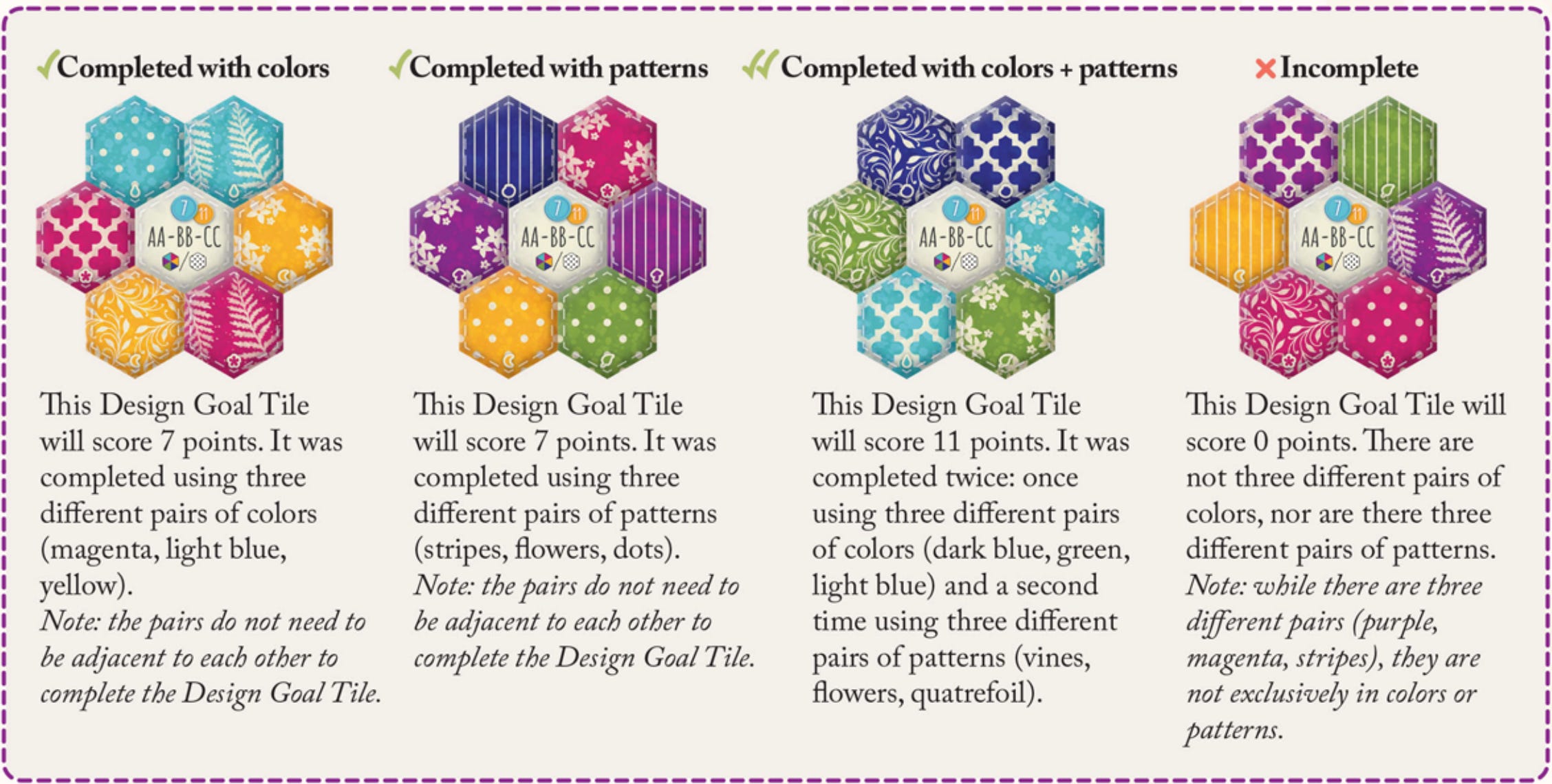
Design goal tiles are a bit difficult to articulate or explain until you play the game, but it’s fairly simple once you start playing. The easiest tile to explain is the AA-BB-CC (example above) design goal tile: The AA-BB-CC goal tile wants three pairs of a color and/or three pairs of a pattern around it. Example:
Colors: Surround the goal tile with 2 yellows, 2 greens, and 2 purples in any arrangement.
Patterns: Surround the goal tile with 2 stripes, 2 dots, and 2 flower patterns in any arrangement.
If you fulfill one condition, you obtain 7 points; if you fulfill both conditions, you score 11 points! Using our previous example, to fulfill both conditions, you’d need to surround the AA-BB-CC goal tile with the following: 2 yellows, 2 greens, and 2 purples patch tiles that also have stripes, dots, and flower patterns on them.
In Calico, you always have to consider two elements: the color of a patch tile and its pattern. Oftentimes, you’ll find yourself in tricky situations where you’ll want to place a tile in so many spots but are forced to pick one, which is a fun challenge.
Game End
The game ends once every player fills their quilt board with patch tiles, giving everyone the same number of turns.
Pros
A perfect game for couples or people who love cats and puzzle-like games.
The quilt boards are never fully perfected, leaving you eager to tackle the core puzzle again after each game.
Players are competing on their own boards, so there is no negative interaction between players.
Every tile placement brings intriguing decisions, pushing players to commit to a strategy without knowing what tiles they’ll draw next.
Calico offers a perfect blend of tactical (turn-to-turn) decisions with long-term planning (strategy).
As the game progresses, your quilt shrinks in size, reducing your options and increasing the level of tension.
Considerations
There is very minimal player interaction between players, other than hate-drafting each other's tiles, making this game ideal for two players and couples.
Butterfly Garden
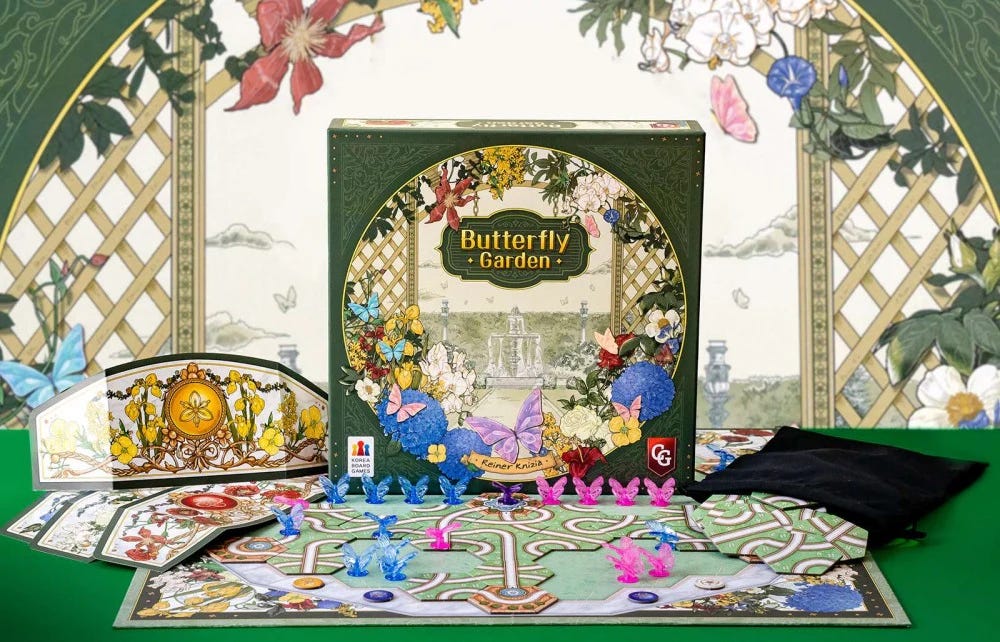
Butterfly Garden is a highly competitive board game with a cozy butterfly theme and surprisingly sharp, competitive gameplay.
Publisher: Capstone Games and Korea Board Games
Category: Abstract Strategy
Main Mechanics: Network and Route Building, Tile Placement, and Point-to-Point Movement
Player Count: 2 to 4 players. Best with 3 or 4 players.
Playing Time: 30 minutes to 40 minutes.
Brief Overview
In Butterfly Garden, players place path tiles on the board and move butterflies along those paths toward their flowerbeds for points. Blue butterflies score one point, pink butterflies score two, and the single purple butterfly scores three points.
Setup
To set up, players place butterfly pieces on fountain tiles located at the edges of the board and in a single spot in the center. Once the board is populated with butterflies, players draw two path tiles and start the game.
Turns
Place a path tile on any open spot on the board. If you place a path tile next to a butterfly, you must move the butterfly along the newly created path, as long as the tile extends the butterfly's current path.
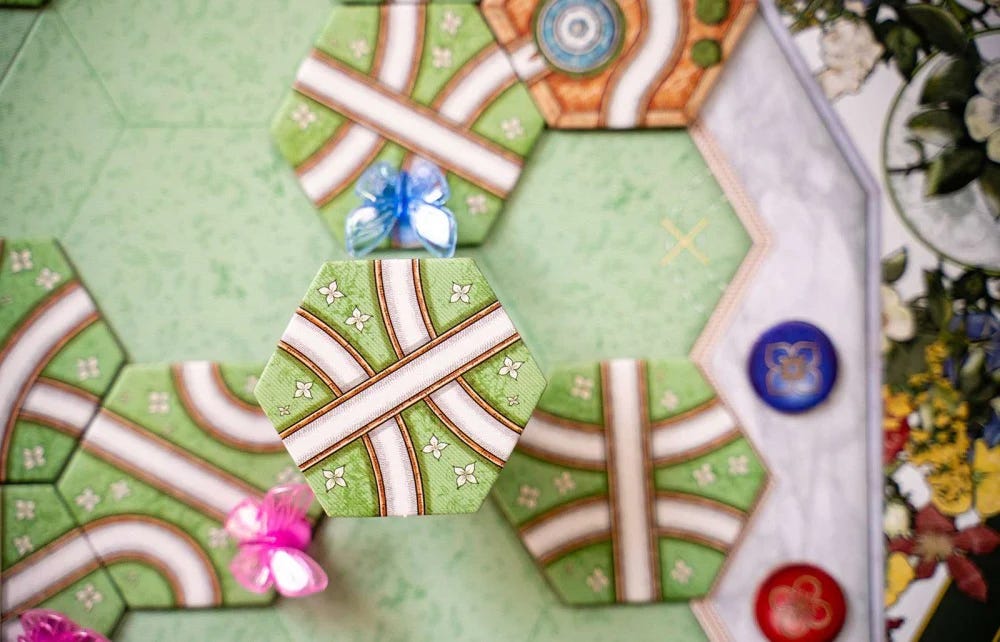
If a butterfly lands on a flowerbed, the player(s) who own it score it.
Finally, draw a path tile from the bag to replenish your hand.
The goal of the game is to maneuver butterflies into your own flowerbed areas for points. Flowerbeds are located on the edges of the board and function like nets that trap butterflies. Flowerbeds can either belong to a single player or be shared by exactly two players, forcing players to work semi-cooperatively to score points. Butterflies earned by players are kept hidden behind their player screens.
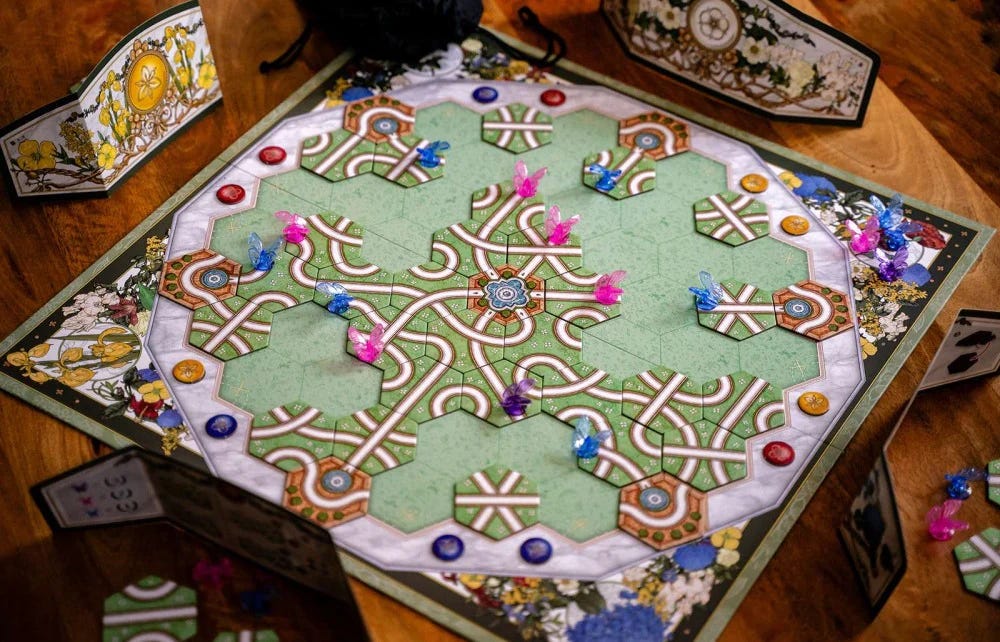
Shared Flowerbeds Lead to Shared Incentives
A flowerbed scoring area might belong to you or be shared with exactly one other player, forcing you to collaborate with others while still trying to advance your agenda.
Game End
The game ends once the last butterfly is collected. Once the game ends, players count their butterflies and determine a winner.
Pros
The game plays fast and has an accessible price point.
The shared goals in the game lead to temporary alliances between all players.
It plays exceptionally well with casual players and competitive gamers.
It has simple rules that are easy to teach without sacrificing gameplay depth.
Tile placements can lead to unexpected changes in routes, forcing other players to adapt or modify their strategies.
Due to the shared incentives in the game, players will often try to influence others’ actions through clever persuasion in hopes of scoring butterflies.
Considerations
Butterfly garden has few downsides, except that it’s a game that won’t really surprise you from game to game. You know what to expect, and that’s precisely what you get. In that regard, it is a very consistent game.
If you’re not a giant fan of abstract games, this title may not be for you. However, everyone I’ve introduced it to has thoroughly enjoyed it.
Follow me on Social Media:
https://www.instagram.com/fandomtribune
https://x.com/fandomtribune